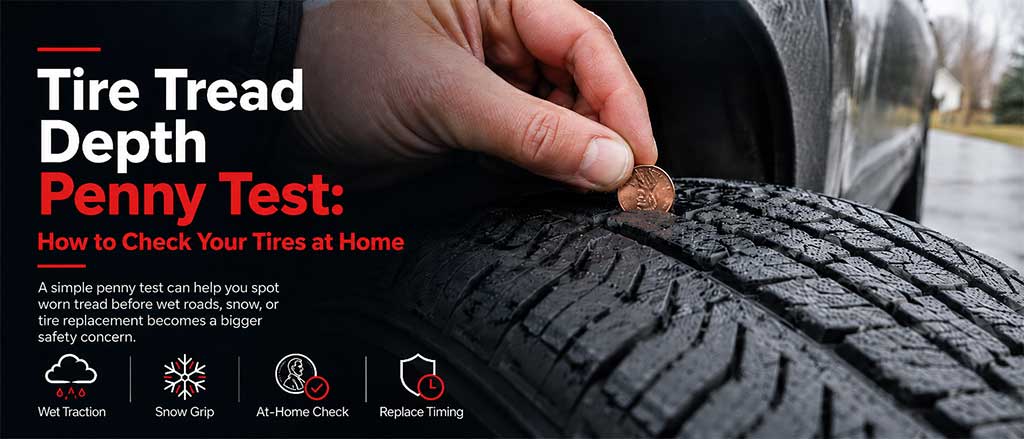
Tires can look usable from the outside and still be close to the point where wet traction starts becoming a concern. That is why a simple tread check matters, especially before rainy weather, long highway drives, or colder months.
The tire tread depth penny test is a quick way to see whether your tires are near the minimum replacement point. It is not the most precise method, but it gives drivers an easy first warning when tread depth is getting too low.
For tire shoppers, this matters because tread depth affects wet braking, hydroplaning resistance, light snow grip, and overall control. A tire review can tell you how a tire performs when it is new, but your own tread depth tells you how much usable grip your current tires may still have left.
What the Tire Tread Depth Penny Test Actually Checks
The penny test checks whether your tire tread is near 2/32 of an inch, which is the common minimum replacement point for passenger tires in the United States. At that depth, the tire has very little usable tread left for moving water away from the contact patch.
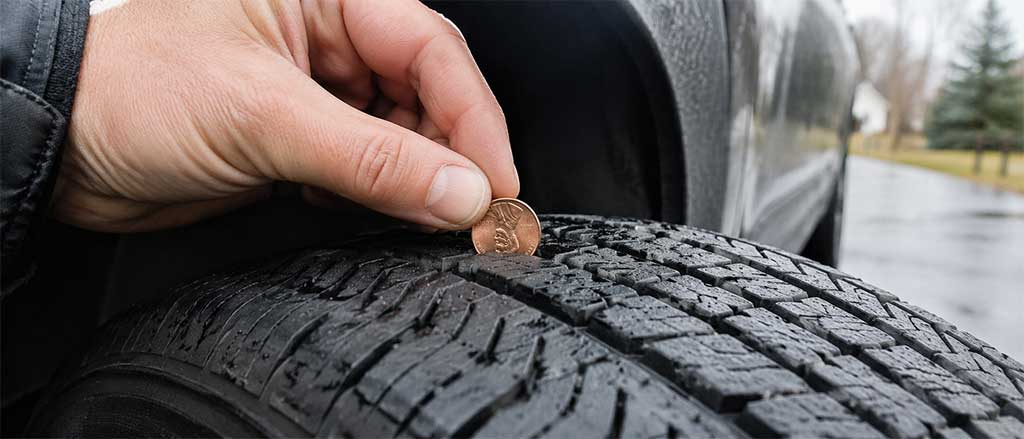
To do the test, place a penny into one of the main tread grooves with Lincoln’s head facing down. If part of Lincoln’s head is covered by tread, the tire has more than 2/32 of an inch in that spot. If you can see all of Lincoln’s head, the tread is too shallow, and the tire should be replaced.
This test is popular because it is simple. Most drivers have a penny nearby, and the result is easy to understand. Still, I would treat it as a basic warning tool, not a full tire inspection.
How to Do the Tire Tread Depth Penny Test the Right Way
Do not check only one groove and call it done. Tires can wear unevenly, so one part of the tread may be deeper than another.
Start by parking on a safe, flat surface. Turn the steering wheel slightly if you need better access to the front tires. Then place the penny into several main grooves across each tire.
Check the inner shoulder, center tread, and outer shoulder. Repeat the test on all four tires. If any major area fails the penny test, the tire should be considered ready for replacement, even if another part still looks acceptable.
This is where many drivers make a mistake. They check the easiest visible groove on the outside edge, see enough tread, and assume the whole tire is fine. The inside edge may be much more worn, especially if alignment, suspension, or tire pressure has not been maintained properly.
Why the Penny Test Matters for Wet Roads
Tread grooves give water somewhere to go. When a tire rolls across a wet road, the tread pattern has to move water away so the tire can stay in contact with the pavement.
As tread wears down, the grooves become shallower. That leaves less room for water to escape, which can reduce wet traction and increase the risk of hydroplaning. Hydroplaning happens when water separates the tire from the road surface, reducing steering and braking control.
No tire can completely prevent hydroplaning. However, tires with healthier tread depth have more ability to manage water than tires worn close to the minimum. Correct tire pressure, slower speeds, and safe following distance are still important.
This is why the penny test should not be treated as the only wet-weather standard. If your tires pass the penny test but are getting close, you may still notice weaker wet braking or less confidence during heavy rain.
Why Snow and Slush Need More Than the Bare Minimum
The penny test mainly tells you whether the tire is near the minimum replacement point. Snow and slush usually need more tread than that.
Light snow, packed snow, and slush need space inside the tread grooves. The tire also needs enough biting edges to grip the surface. As the tread wears down, the tire has less ability to clear loose material and maintain traction.
This is especially important if you drive in areas that get cold rain, occasional snow, or mountain weather. A tire that barely passes the penny test may not give the traction you want in winter conditions.
All-weather tires and winter tires can help in the right conditions, but they still depend on enough remaining tread depth. A worn tire with a snow rating should not be judged the same way as that same tire when new.
The Penny Test Is Useful, But It Has Limits
The penny test is helpful because it gives a quick answer. If the top of Lincoln’s head is visible, the tire is worn to the point where replacement should not be delayed.
However, the test does not measure tread depth exactly. It does not tell you whether you have 5/32, 4/32, or 3/32 of an inch left. It also does not diagnose uneven wear, tire age, sidewall damage, cracking, puncture repairs, alignment problems, or internal tire damage.
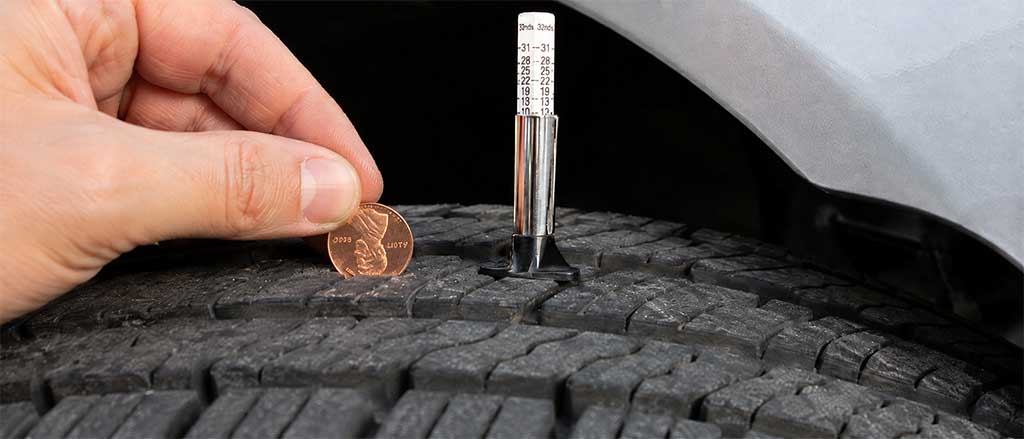
That is why I prefer using the penny test as a first step. If the tire looks close, use a tread depth gauge for a more accurate reading. A gauge is inexpensive and gives you a clear number, which helps when deciding whether the tire is still right for your weather and driving needs.
When a Tread Depth Gauge Is Better
A tread depth gauge is better when you want a specific measurement. Instead of guessing from a coin, the gauge tells you how many 32nds of an inch remain.
That matters when comparing tires or deciding whether to replace them before a rainy or snowy season. A tire may pass the penny test but still be low enough that wet traction is not where you want it.
A gauge also helps you spot uneven wear. If the center reads lower than the shoulders, tire pressure may be part of the issue. If one shoulder is lower than the other, alignment or suspension condition may need attention.
For real-world tire ownership, those details matter. Replacing tires solves worn tread, but it does not fix the problem that caused uneven wear in the first place.
What Tire Shoppers Should Learn From the Penny Test
The penny test teaches a simple tire-buying lesson: tread condition matters as much as tire category. A tire can have good reviews, strong ratings, and the right label for your vehicle, but it still needs enough tread to perform safely.
When shopping for new tires, pay attention to how reviews discuss wet traction, wet braking, hydroplaning resistance, snow traction, and treadwear. Those categories connect directly to what happens as a tire wears.
A tire with strong wet performance when new may not feel the same after thousands of miles. A long treadwear warranty can be useful, but it does not replace regular inspection. A tire with good light-snow capability still needs enough tread depth before winter weather arrives.
The penny test helps you think about tires as something that changes over time. New-tire performance is only the starting point. The real ownership question is how well the tire continues to meet your needs as the tread wears.
Signs You Should Check Your Tires Soon
You do not need to wait for a warning light or a visible problem. Check your tread if you notice any change in wet-road confidence, braking feel, or steering response.
You should also check before a long trip, before rainy weather, before winter driving, and after hitting a pothole or curb. If your vehicle starts pulling, vibrating, or making more tire noise than usual, inspect the tread and look for uneven wear.
Also pay attention to tire age and visible condition. Tread depth is important, but cracks, bulges, cuts, exposed cords, or sidewall damage are separate safety concerns. A tire can have remaining tread and still be unsafe.
Common Mistakes Drivers Make With the Penny Test
One common mistake is checking only one tire. Front and rear tires can wear at different rates, especially depending on drivetrain layout, steering load, vehicle weight, and rotation habits.
Another mistake is testing only the outside edge. The inside edge can wear faster and may be hard to see without turning the wheel or checking carefully.
Some drivers also think passing the penny test means the tire is excellent in rain. It does not. Passing only means the tire appears to have more than 2/32 of an inch in the tested groove. Wet traction can decline before that point.
A final mistake is ignoring why the tire wore down unevenly. If one tire fails the penny test much sooner than the others, the vehicle may need rotation, alignment, suspension inspection, or tire pressure correction.
Quick Buyer Takeaway for the Penny Test
Use the penny test as a fast warning check, not the only tire inspection.
Insert the penny with Lincoln’s head facing down into the main tread grooves.
Check multiple spots across each tire, including the inner edge, center, and outer edge.
Replace the tire if all of Lincoln’s head is visible in any major tread area.
Use a tread depth gauge for a more accurate number before rainy or snowy seasons.
Watch for uneven wear, because it can point to pressure, rotation, alignment, or suspension issues.
Do not wait for poor traction to confirm worn tread. Check before weather or road conditions expose the problem.
Final Takeaway on the Tire Tread Depth Penny Test
The penny test is not perfect, but it is one of the easiest ways to spot tires that are getting too worn. It gives drivers a quick visual check before tread depth turns into a wet-road or snow-traction problem.
For tire buyers, the bigger lesson is to think beyond how a tire performs when new. Tread depth changes the way a tire handles water, slush, braking, steering, and long-term confidence.
A penny can tell you when a tire is near the minimum. A tread depth gauge can tell you more. Regular checks, proper pressure, tire rotation, and timely replacement give you the best chance of getting the safety, value, and performance your tires were chosen for in the first place.